

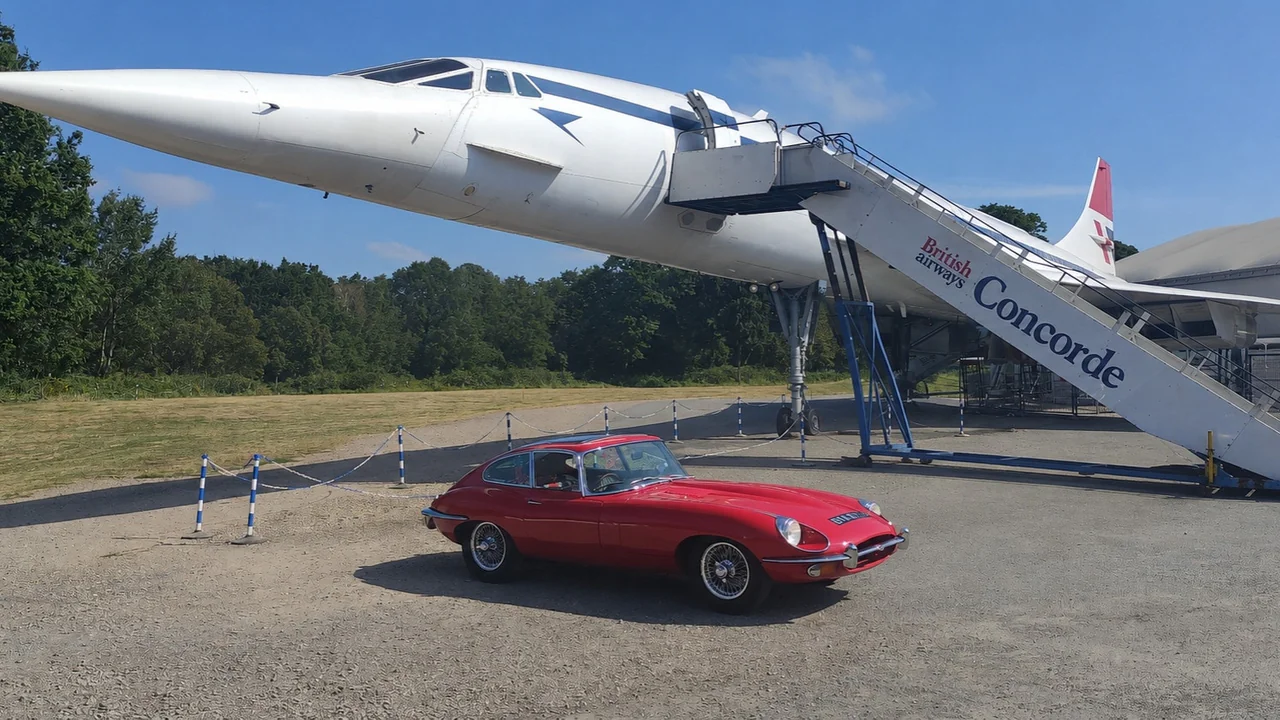
Jaguar E-Type: Hire Guide
The Jaguar E-Type (1961–1975) is the archetypal British grand tourer: long bonnet, twin-cam straight-six (later V12), independent rear suspension, and looks Enzo Ferrari called the most beautiful car ever made. Three series across roadster, fixed-head coupé, and 2+2 bodies. Best suited to fine-weather driving, weddings, and photography rather than long motorway hauls.
At a glance
The Jaguar E-Type (1961–1975) is the archetypal British grand tourer: long bonnet, twin-cam straight-six (later V12), independent rear suspension, and looks Enzo Ferrari called the most beautiful car ever made. Three series across roadster, fixed-head coupé, and 2+2 bodies. Best suited to fine-weather driving, weddings, and photography rather than long motorway hauls.
Specifications
1961–1975
- Years produced
- 1961–1975
- Series
- I (1961–1968), II (1968–1971), III (1971–1975)
- Engine: Series I & II
- 3.8 / 4.2 L XK twin-cam straight-six
- Engine: Series III
- 5.3 L V12, SOHC per bank
- Power
- 265 bhp (3.8 six) / 272 bhp (V12, gross figures)
- Top speed (period claim)
- ≈ 150 mph / 241 km/h
- Body styles
- Roadster (OTS), Fixed-Head Coupé (FHC), 2+2 (from 1966)
- Drivetrain
- Front engine, rear-wheel drive, 4-speed manual (auto on V12)
- Notable features
- Monocoque with front subframe, independent rear suspension, all-round disc brakes
History
Launched at the 1961 Geneva Motor Show, the E-Type was Jaguar's road-going successor to the Le Mans–winning D-Type. It packaged independent rear suspension and disc brakes, both unusual at the time, into a body designed by aerodynamicist Malcolm Sayer. Series I cars (1961–1968) used a 3.8 L and later 4.2 L XK six. Series II (1968–1971) introduced US-friendly bumpers, larger lights, and a more comfortable cabin. Series III (1971–1975) moved to a 5.3 L V12 with a longer wheelbase, available as roadster and 2+2.
What it's like to drive
An E-Type is fast in a 1960s sense: torquey enough to feel modern from a standstill, but unassisted steering, a heavy clutch, and Moss (early) or all-synchro (1965+) gearboxes ask for deliberate inputs. The cabin is narrow, the screen low, and the driving position long-armed. The reward is the noise: the XK six has a hard-edged metallic howl, while the V12 has a creamy turbine sweep. Best on B-roads in dry weather; long motorway runs are tiring and exposed roadsters can be loud above 70 mph.
What occasions it suits
The E-Type is a top three wedding car in the UK and a perennial film and TV vehicle. It photographs beautifully from any angle and looks credible in any era from the early 1960s to the mid-1970s. Couples often hire one for short transfers between ceremony and reception; production companies hire them for period drama and lifestyle commercials. As a driving experience, it suits a one- to three-day Cotswolds or Highland tour better than a week-long European trip.
Cultural appearances
- Enzo Ferrari reportedly called the E-Type 'the most beautiful car ever made'.
- A 3.8 roadster is in the permanent collection of New York's Museum of Modern Art (MoMA).
- Driven by Diana Rigg's Emma Peel in The Avengers, by Austin Powers, and by Jay Kay of Jamiroquai (Series I roadster).
- Princes William and Harry rode in an E-Type Concept Zero (electric conversion) after Harry's 2018 wedding.
What occasions it suits
- Wedding car (ceremony arrival or short transfers)
- Film & TV picture car (1960s–1970s period)
- Birthday and anniversary driving experiences
- Fashion and lifestyle photo shoots
- Concours and rally entries (Tour Auto, Mille Miglia Storica via 2+2)
Live Jaguar E-Type listings
Frequently asked questions
- How much does it cost to hire a Jaguar E-Type?
- Typical day rates on BookAclassic range from £450 to £1,200, depending on series, body style, condition, and whether you take it self-drive or chauffeured. Roadsters and matching-numbers Series I cars sit at the top of the range.
- Can I drive an E-Type myself?
- Yes, many owners offer self-drive subject to age (usually 30+), licence checks, and a security deposit. Some Series I cars and concours examples are available only with a chauffeur; the listing will state which.
- Is the Jaguar E-Type reliable for a long road trip?
- An E-Type in good order is reasonably reliable for one- to three-day trips, but it's a 50–60-year-old car. Plan for shorter daily distances (≤200 miles), avoid heavy motorway use in summer (cooling) and check the owner's preferred touring radius before booking.
- Series I, II, or III: which should I hire?
- Series I is the purest design and the most valuable. Series II is the easiest to live with day-to-day (better cooling, brakes, ergonomics). Series III V12 is the most relaxed grand tourer but heavier and thirstier. For a wedding pick Series I or II roadster; for a long drive consider Series II FHC or III 2+2.
Find your classic on BookAclassic
Browse thousands of classic and prestige cars from owners across the UK, Europe, Australia, New Zealand, South Africa, and Canada.
Last reviewed 2026-05-14